 towngameh5.com
Autonauts Tips & Guide: Essential Strategies for Automation, Resource Management, and Building a Self-Sufficient Colony

Autonauts is a charming automation and colony-building game that challenges players to transform an undeveloped planet into a thriving settlement. Instead of manually completing every task, you build robots, teach them simple instructions, and gradually create automated systems that gather resources, manufacture goods, and support a growing population. What begins as a small survival project can eventually become an intricate production network filled with specialized machines and carefully coordinated workflows.
The game's greatest strength is its programming system. Robots do not automatically understand what you want them to do. You must demonstrate tasks, record their actions, and organize their routines so they can repeat the work independently. This creates a satisfying progression from basic manual labor to increasingly sophisticated automation.
However, expanding too quickly can create problems. Robots may run out of storage, production lines can become disconnected, and settlers may demand goods that your colony cannot yet produce reliably. Efficient progress depends on understanding the relationship between resources, robot programming, manufacturing, and settlement development.
This guide covers ten essential areas, from establishing your first automated resource loops to optimizing complex production networks. Whether you are starting a new world or trying to improve an existing colony, these strategies will help you build a more organized and productive settlement.
1. Understand the Core Gameplay Loop
Autonauts revolves around three interconnected activities: gathering resources, automating work, and developing your settlement. Early on, you will perform many tasks yourself, including collecting materials, crafting basic tools, and preparing the first robots. As automation expands, your role gradually shifts from doing the work to designing systems that do it for you.
The most important principle is that every repetitive task is an opportunity for automation. Collecting sticks, harvesting plants, transporting materials, and crafting basic components can all become robot responsibilities. The time saved by automating simple activities can then be invested in unlocking new technologies and solving more complicated production problems.
Prioritize tasks that repeat frequently
Not every activity deserves a robot immediately. A task performed once or twice may be faster to complete manually than to automate. Repetitive jobs, on the other hand, can save considerable time when delegated to a reliable worker.
Start by identifying activities that interrupt your progress most often. If you repeatedly stop building to collect wood, automate wood collection. If crafting components consumes too much time, create a dedicated crafting routine.
Useful early automation targets include:
- Collecting sticks, stones, and other common resources.
- Harvesting renewable plants.
- Moving materials from gathering areas to storage.
- Producing frequently used basic components.
- Replenishing supplies used by construction projects.
Build gradually instead of automating everything
A common mistake is trying to automate an entire colony before understanding the individual tasks. Complex routines are harder to troubleshoot, especially when several robots depend on the same storage area or resource supply.
Begin with one reliable robot performing one clearly defined job. Once that system works consistently, expand it with additional workers or connect it to another production stage.
This approach makes failures easier to identify and prevents a small programming mistake from disrupting the entire settlement.
2. Establish a Reliable Early-Game Resource Supply
Resources are the foundation of every successful colony. Wood, stone, plant materials, and crafted components are needed for robots, buildings, tools, and research. Running out of a basic resource can halt several projects simultaneously, so dependable supply systems should be established before pursuing ambitious expansion.
Start by exploring the immediate surroundings and identifying useful resource locations. Look for areas with renewable materials, convenient access, and enough space to support repeated harvesting. Keeping early operations close together also reduces the amount of transportation work required.
Separate gathering from storage
A gathering robot should have a clear destination for its resources. Without a sensible storage arrangement, workers may spend too much time walking between scattered stockpiles or become unable to deposit collected items.
Organize storage around the materials your colony uses most often. Frequently needed resources should be easy to reach, while specialized or rarely used components can be stored elsewhere.
A practical starting arrangement includes:
- A wood storage area near the main gathering location.
- A separate area for stone and other construction materials.
- Dedicated storage for crafted components.
- Accessible supplies for robot construction and maintenance.
- Enough empty storage space to accommodate production growth.
Account for renewable and limited resources
Some resources can be collected repeatedly from renewable sources, while others require exploration or more deliberate management. Learn which materials are readily replenished and avoid building a production system that depends on a supply you cannot maintain.
When a resource becomes scarce, adjust the workflow before the shortage stops production. You might move the gathering area, establish a second worker, or reduce unnecessary consumption.
Reliable supply matters more than impressive output. A small system that consistently produces enough materials is more valuable than a large system that frequently runs out of inputs.
3. Master Robot Programming Basics
Robot programming is the defining mechanic of Autonauts. You teach a robot by recording a sequence of actions, allowing it to repeat those actions without your direct involvement. The challenge is to create routines that are clear, efficient, and capable of handling ordinary changes in the environment.
A basic routine might involve moving to a resource, collecting it, returning to storage, depositing the item, and repeating the process. Although simple, this sequence introduces the essential principles behind more advanced automation.
Give each robot a specific responsibility
Specialized robots are generally easier to manage than robots assigned to many unrelated tasks. A worker that gathers wood should not also be responsible for manufacturing tools, transporting food, and building structures unless there is a compelling reason.
Focused routines make it easier to understand what each robot is supposed to accomplish. They also reduce the chance that one task will interfere with another.
When designing a routine, ask yourself:
- What is the robot's primary objective?
- Where does it obtain the required materials?
- Where should completed work or collected items go?
- What happens when the destination is full?
- Can the robot repeat the routine without manual intervention?
Keep programs simple and test them
A long routine may look efficient because it combines several jobs into one program. However, a complicated sequence can be difficult to diagnose when something goes wrong.
Test new programs with a small number of actions first. Confirm that the robot can reach the correct locations, interact with the intended objects, and complete its cycle successfully.
Once the basic routine works, add improvements incrementally. If a new instruction causes a problem, you can identify the likely source without rebuilding the entire program.
4. Improve Robot Efficiency and Avoid Common Programming Errors
As your colony grows, the number of active robots becomes less important than how effectively they work. Poorly designed routines can cause workers to wander, repeat unnecessary actions, compete for the same resources, or remain idle while waiting for materials.
Efficiency begins with observing actual behavior. Watch a robot complete several cycles and look for unnecessary movement, repeated searching, or long waits. A routine that appears correct when examined on paper may still be inefficient in practice.
Design around complete work cycles
A dependable worker should be able to complete its assignment from beginning to end. For example, a harvesting robot should have a clear collection area and a reliable way to deliver its output.
If the robot repeatedly collects materials but cannot deposit them, its storage capacity may be insufficient or its destination may be unavailable. If it travels long distances between each action, relocating storage or adjusting the work area may produce a significant improvement.
Common problems include:
- Full inventory: The robot cannot collect more items or finish its task.
- Missing resources: The routine expects materials that are unavailable.
- Incorrect destinations: Items are delivered to the wrong stockpile or workstation.
- Unnecessary movement: Storage and work areas are poorly positioned.
- Interrupted routines: One action depends on an object or condition that is no longer available.
Improve one bottleneck at a time
When a production line slows down, avoid changing every robot simultaneously. Identify the stage that limits output and improve that stage first.
For example, increasing the number of woodcutters will not solve a shortage caused by a slow crafting station. Similarly, adding more crafting robots will not help if there is insufficient raw material.
Measure success through completed output and consistent operation rather than the number of robots assigned to a job.
5. Build Efficient Crafting and Production Chains
Crafting turns raw materials into the components needed for more advanced buildings, tools, and automation systems. As production becomes more complicated, it is useful to think of crafting as a sequence of connected stages rather than a collection of individual recipes.
A typical production chain may begin with resource gathering, continue through material preparation, and finish with crafting a component used by another building. Each stage depends on the previous one, so interruptions can affect the entire chain.
Organize production by function
Grouping related workstations reduces unnecessary transportation and makes the colony easier to understand. Place frequently connected production steps near one another when practical.
For instance, raw materials can be stored near the stations that process them, while finished components can be delivered to a central storage area or a nearby manufacturing station.
A useful organizational structure includes:
- Raw material collection.
- Initial processing and preparation.
- Component manufacturing.
- Storage for completed goods.
- Distribution to construction and settlement needs.
The precise arrangement will depend on your available space and unlocked technologies, but the underlying principle remains the same: minimize unnecessary movement between dependent tasks.
Balance inputs with output requirements
Producing large quantities of one component is not always beneficial. If a crafting station consumes all available wood or plant materials, other essential systems may stop functioning.
Before expanding a production line, consider how much material it consumes and whether the colony can sustain that demand. Adjust worker assignments and storage priorities to keep important systems supplied.
It is also helpful to maintain a modest reserve of frequently used components. This prevents construction projects from repeatedly interrupting ordinary production.
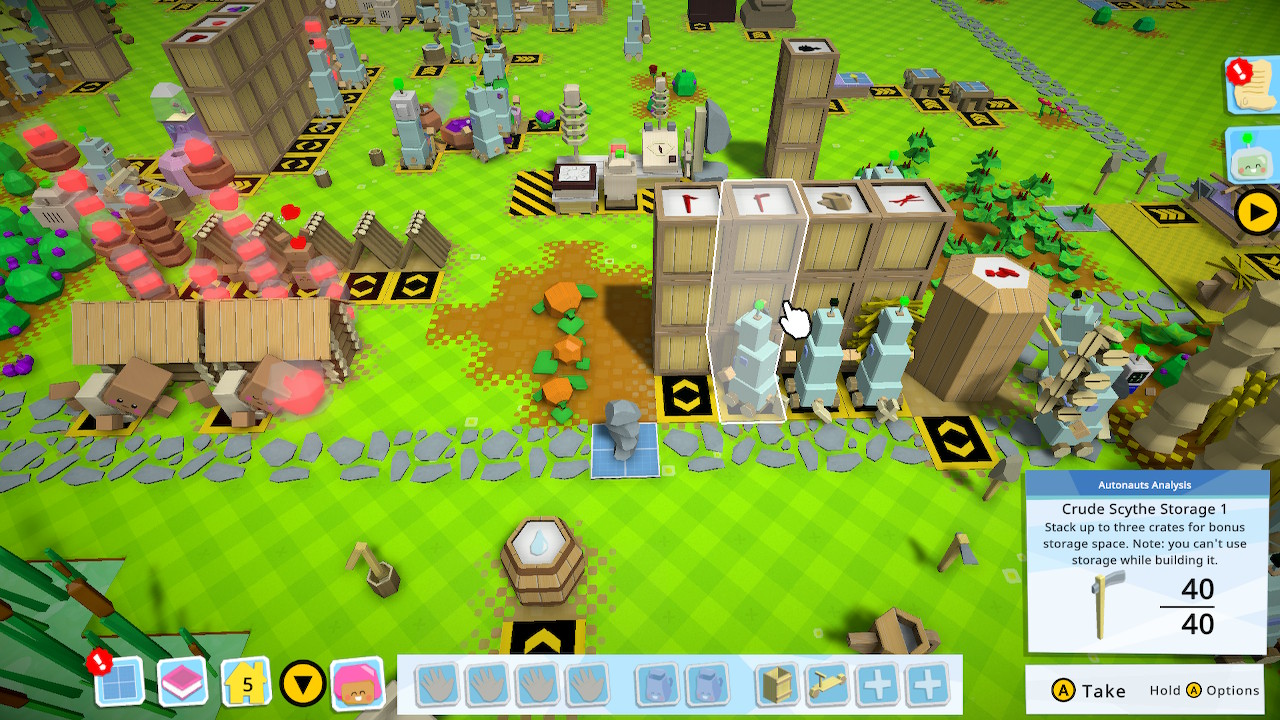
6. Develop Your Settlement and Meet Population Needs
Autonauts is not only about collecting resources and building robots. The settlement development system gives your automation network a broader purpose. As you support settlers and meet their needs, the colony progresses and introduces additional demands that require more advanced production.
This creates a natural challenge: every new stage can require goods that your existing systems were not designed to produce. Expansion should therefore be matched by improvements to resource gathering, manufacturing, and distribution.
Understand demand before expanding
When settlers request goods, identify the full production chain required to supply them. Some items may be simple to manufacture, while others depend on several intermediate components.
Do not immediately promise a steady supply of every newly requested product. First determine whether you have enough raw materials, appropriate workstations, and reliable transportation.
A useful checklist is:
- Identify the requested item and its ingredients.
- Confirm that the required resources are available.
- Establish or adapt the necessary production stages.
- Provide storage for the finished goods.
- Test the workflow before depending on it for continued progress.
Avoid neglecting basic infrastructure
Population growth can encourage players to focus on advanced products, but the colony still depends on ordinary materials and dependable robots. If basic supply systems become unreliable, new production chains may stop at inconvenient times.
Keep gathering and manufacturing operations stable while introducing settlement upgrades. A balanced colony progresses more smoothly than one that pursues new demands while neglecting its foundations.
7. Unlock Technology at the Right Pace
Research and technological progression allow your colony to access new tools, production possibilities, and more sophisticated systems. The challenge is deciding which developments will provide the greatest benefit to your current situation.
Researching everything as soon as it becomes available can spread resources too thinly. Instead, focus on technologies that remove an existing bottleneck or make an important future goal achievable.
Choose research based on current needs
Before pursuing a technology, consider what it will change in your colony. Will it make a frequently used process easier? Will it unlock an essential component? Does it support a production chain that you are already preparing to build?
Prioritize developments that create practical improvements rather than researching randomly.
Useful priorities often include technologies that support:
- More dependable automation.
- Better access to important resources.
- Essential crafting and manufacturing.
- Increased production capacity.
- The next stage of settlement development.
The best choice will change as your colony grows. An early technology that helps establish basic production may become less important once your infrastructure is stable.
Prepare the resources before committing to a project
Research and construction can consume materials that are also needed elsewhere. Before beginning a major development, check your current reserves and ensure that basic production will continue.
It can be helpful to create a temporary reserve for a specific project. Once enough materials have been collected, use them for the planned upgrade without exhausting the supplies required by everyday operations.
This reduces the risk of reaching a new milestone only to discover that the colony can no longer maintain its essential workflows.
8. Manage Storage, Transportation, and Logistics
Logistics becomes increasingly important as the settlement expands. Even a well-designed production line can perform poorly if workers spend too much time carrying materials or if essential components are stored far from the places where they are needed.
Think of transportation as a production stage in its own right. Gathering, processing, crafting, and delivery must all work together for the final product to reach its destination.
Design storage around material flow
Place storage where it supports the work being performed. Materials used constantly should be easy to access, while finished products may need to be collected in a separate area for distribution.
Avoid scattering stockpiles without a clear purpose. An organized layout helps you understand where supplies are located and makes it easier to spot shortages.
As the colony grows, consider dividing storage into practical categories:
- Frequently used raw materials.
- Intermediate crafting components.
- Finished products.
- Materials reserved for construction or research.
- Supplies that are produced in excess and can be stored farther away.
Reduce unnecessary transportation
Long-distance delivery consumes time and can create congestion when many robots use the same routes. Relocating a stockpile or workstation may be more effective than adding another worker.
If several production stages depend on the same component, consider how to distribute that component efficiently. A central storage area can be useful for general supplies, while nearby local storage may be better for materials consumed constantly by one workstation.
There is no single perfect layout for every colony. Review your actual traffic patterns and make adjustments when production becomes slow or difficult to manage.

9. Scale Automation for Midgame and Late-Game Progress
Once the basic systems are stable, the main challenge becomes coordinating a larger network of robots, production lines, and settlement requirements. At this stage, adding more workers is only one part of the solution. The colony also needs clear responsibilities, dependable supply chains, and enough capacity to handle increased demand.
Start by identifying the systems that are already working reliably. Preserve those routines while expanding into new areas, rather than redesigning everything whenever a new technology becomes available.
Expand through modular production
A modular approach means building production systems that have clear inputs, outputs, and responsibilities. One group of robots gathers resources, another prepares materials, and another manufactures finished components.
This makes the colony easier to expand. If demand for a particular product increases, you can strengthen the relevant production stage without necessarily rebuilding unrelated systems.
For example, a mature colony might use separate groups for:
- Resource gathering and replenishment.
- Basic component production.
- Specialized manufacturing.
- Material transportation and distribution.
- Settlement support and essential goods.
These roles can be adapted to your available technologies and the demands of your world.
Create resilience instead of relying on one worker
A production line that depends on a single robot may stop completely when that worker becomes blocked or cannot complete its routine. Important systems should be designed with enough capacity and flexibility to recover from ordinary interruptions.
Depending on the task, this may mean adding another worker, keeping a reserve of key materials, or ensuring that alternative supply routes exist.
However, redundancy should be applied selectively. Duplicating every worker wastes resources and can make the colony harder to manage. Focus on systems whose failure would stop several other processes or prevent essential progression.
10. Advanced Optimization, Troubleshooting, and Long-Term Planning
Advanced Autonauts gameplay is about improving the entire colony rather than maximizing one isolated activity. A fast harvesting routine is useful, but its value decreases if the harvested materials cannot reach manufacturing. Likewise, a powerful crafting system is less useful when it consumes resources faster than the colony can replace them.
The best improvements usually come from examining how different systems interact. Consider the complete journey of a material, from its original source to its final use. Every unnecessary action, long trip, or avoidable interruption is an opportunity to improve efficiency.
Audit the colony regularly
Set aside time to review your robots and production lines. Look for workers that remain idle, stations that frequently lack inputs, and stockpiles that accumulate goods nobody needs.
A simple audit can follow this sequence:
- Identify an important product that is consistently in short supply.
- Trace its production chain backward to find the limiting stage.
- Check whether the problem comes from resources, crafting, storage, or transportation.
- Make one targeted change.
- Observe the results before making further adjustments.
This method prevents you from solving the wrong problem. If a finished product is scarce because its raw materials are unavailable, adding more crafting robots will not address the underlying cause.
Plan for sustainable growth
A strong colony should be able to maintain its essential operations while you work on new objectives. Keep core resources flowing, ensure that critical production chains have adequate capacity, and avoid consuming every available component on expansion.
It is also worth keeping robot routines understandable. Clear, specialized programs are easier to repair and adapt than complicated routines that have accumulated many unrelated tasks.
Finally, remember that optimization is an ongoing process. As new technologies, settlers, and production demands appear, yesterday's ideal layout may no longer be the best arrangement. Review the colony periodically and improve it in manageable steps.
Conclusion
Autonauts rewards patience, experimentation, and thoughtful automation. The most successful colonies are not necessarily the ones with the greatest number of robots, but the ones whose workers perform clear tasks within reliable production systems.
Start by automating repetitive resource collection, learn to create simple and dependable robot programs, and organize crafting around sensible material flows. As the colony develops, balance settlement needs with research, storage, and transportation. When problems arise, identify the actual bottleneck before adding more workers or rebuilding entire systems.
Above all, treat every new production chain as part of a larger network. A well-organized colony can gather resources, manufacture goods, and support its settlers with far less manual intervention, allowing you to focus on the next challenge rather than constantly repairing the last one.
Description: Master Autonauts with practical tips for robot programming, resource gathering, crafting, settlement growth, storage, and efficient colony automation.